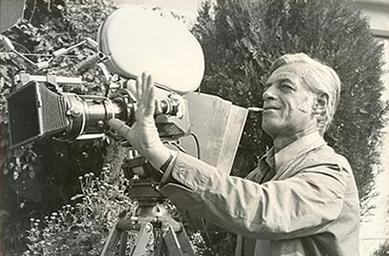
Krešimir "Krešo" Golik (20 May 1922 – 20 September 1996) was a Croatian film and television director and screenwriter. In a creative career spanning five decades between the late 1940s and late 1980s, Golik directed a number of critically acclaimed feature films, short subjects and television series. Working almost exclusively at Zagreb-based production companies Jadran Film, Zagreb Film and Croatia Film, Golik is regarded as one of the most important directors in Croatian cinema and his 1970 comedy One Song a Day Takes Mischief Away is widely regarded as the greatest Croatian film ever made.
Krešimir "Krešo" Golik (20 May 1922 – 20 September 1996) was a Croatian film and television director and screenwriter. In a creative career spanning five decades between the late 1940s and late 1980s, Golik directed a number of critically acclaimed feature films, short subjects and television series.
Working almost exclusively at Zagreb-based production companies Jadran Film, Zagreb Film and Croatia Film, Golik is regarded as one of the most important directors in Croatian cinema and his 1970 comedy One Song a Day Takes Mischief Away is widely regarded as the greatest Croatian film ever made.
According to Croatian film scholar Ivo Škrabalo, Golik was "the only Croatian film-maker who managed to retain his integrity in all the periods of the post-war Croatian cinema, from its beginnings in the service of the propaganda of the victorious communist system to the last years of its existence".
0 comentarii0 vizualizări0 reacții
Krešo Golika lăsat un gând
acum 19 ore
Life and career Golik was born in Fužine, where he completed his primary education. He went to the Gymnasium and the schools of graphic design in Senj and Zagreb. He worked as a sports journalist on Radio Zagreb and a director of newsreels in Jadran Film. In 1947, Golik started his professional film career. His first feature film was Plavi 9 (Blue 9, 1950), a mixture of the Soviet-style industrial epic, romantic comedy, and football film, and is famous for its football sequences. After its release, it quickly became the biggest hit of the then-young Yugoslavian cinema. During the 50s, Golik also directed Djevojka i hrast (The Young Girl and the Oak, 1955). During the 1960s, it was revealed that Golik worked as a journalist during the fascist Ustashe regime when he was a teenager. Golik was thus banned from directing for almost a decade but continued working as an assistant. His comeback was marked by the anthological documentary Od 3 do 22 (From 3 to 22, 1966). His melodramatic comedy films I Have Two Mothers and Two Fathers (1968) and One Song a Day Takes Mischief Away (1970) were the pinnacle of his career. The first explores the transformation…
0 comentarii0 vizualizări0 reacții
Krešo Golika lăsat un gând
acum 19 ore
Plavi 9 (1950; director and writer)
The Girl and the Oak (Djevojka i hrast, 1955; director)
0 comentarii0 vizualizări0 reacții
Krešo Golika lăsat un gând
acum 19 ore
Kala (1958; director)
Martin in the Clouds (Martin u oblacima, 1961; writer)
0 comentarii0 vizualizări0 reacții
Krešo Golika lăsat un gând
acum 19 ore
Nikoletina Bursać (1964; writer)
I Have Two Mothers and Two Fathers (Imam dvije mame i dva tate, 1968; director and writer)
One Song a Day Takes Mischief Away (Tko pjeva zlo ne misli, 1970; director and writer)
To Live on Love (Živjeti od ljubavi, 1973; director and writer)
0 comentarii0 vizualizări0 reacții
Krešo Golika lăsat un gând
acum 19 ore
Violet (Ljubica, 1978; director)
The Orchid Villa (Vila Orhideja, 1988; director and writer)
0 comentarii0 vizualizări0 reacții
Krešo Golika lăsat un gând
acum 19 ore
Krešo Golik at IMDb
Krešo Golik biography at Filmski-Programi.hr (in Croatian)
Krešo Golik biography at Film.hr (in Croatian)