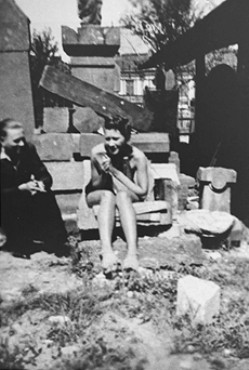
Zofia Baniecka (12 May 1917 in Warsaw – 1993) was a Polish member of the Resistance during World War II. In addition to relaying guns and other materials to resistance fighters, Baniecka and her mother sheltered over 50 Jews in their home between 1941 and 1944. Later, Baniecka was an activist with the Intervention Bureau of the Polish Workers' Defence Committee (Polish: Komitet Obrony Robotników, KOR) in 1977. She and her husband were active participants in the Solidarity movement in the 1980s, distributing underground press. In her professional capacity, Baniecka was a long-time member of the
Zofia Baniecka (12 May 1917 in Warsaw – 1993) was a Polish member of the Resistance during World War II. In addition to relaying guns and other materials to resistance fighters, Baniecka and her mother sheltered over 50 Jews in their home between 1941 and 1944. Later, Baniecka was an activist with the Intervention Bureau of the Polish Workers' Defence Committee (Polish: Komitet Obrony Robotników, KOR) in 1977. She and her husband were active participants in the Solidarity movement in the 1980s, distributing underground press. In her professional capacity, Baniecka was a long-time member of the Warsaw chapter of the Association of Polish Artists and Designers (ZPAP).
0 comentarii9 vizualizări0 reacții
Zofia Banieckaa adăugat o fotografie
ieri
R.I.P Zofia
Life Born fifteen years after her parents' wedding, Zofia Baniecka was the only child of a sculptor father and a teacher mother from Warsaw. Her parents were not religious but she went to a Catholic school. She then studied at the Warsaw University, before the Nazi German and Soviet invasion of Poland. Zofia had many Jewish friends from assimilated homes just like her own intellectually inclined parents. In late 1940 the Nazi occupiers ordered the family to relocate when their home fell within the boundaries of the newly established Warsaw Ghetto. All three family members began to work for the Polish underground. In Zofia's case, she became affiliated with the Bataliony Chłopskie. Zofia's inconspicuous grey-haired mother was transporting weapons in her shopping bag for the Resistance, while Zofia's father smuggled food and books to friends in the Ghetto. Thanks to help from their underground contacts, the family soon moved to a large apartment with four rooms and a kitchen — near the walls of the ghetto — and began taking in Jewish refugees. The apartment was divided by curtains with a different Jewish family behind each one. Nobody was ever refused: friends, strangers, acquaintances. Zofia got involved with the underground…
0 comentarii9 vizualizări0 reacții
Zofia Banieckaa adăugat o fotografie
ieri
R.I.P Zofia
Remembrance
She was recognized as a Righteous Among the Nations, posthumously, in 2016.
0 comentarii9 vizualizări0 reacții
Zofia Banieckaa lăsat un gând
ieri
Shoah
Rescue of Jews by Poles during the Holocaust
Żegota, the Polish Council to Aid Jews
0 comentarii9 vizualizări0 reacții
Zofia Banieckaa lăsat un gând
ieri
Further references
Gay Block, and Malka Drucker, Rescuers: Portraits of Moral Courage in the Holocaust. Holmes & Meier, New York, 1992, pp. 163–4. Content available at USHMM website's time sensitive page #1, and #2
Michael Harrington, Find A Grave: Zofia Baniecka
Rochelle L. Millen, Jack Mann, Timothy Bennett, New Perspectives on the Holocaust Publisher NYU Press 1996, ISBN 0-8147-5540-2