Jan Kubíček (30 December 1927 – 14 October 2013) was a Czech painter and printmaker, and one of the most radical Central European exponents of constructivist and concrete art. He also spent more than a decade illustrating children's books for Czechoslovakia's main publishing house Albatros and designed iconic film posters and book covers throughout the 1960s. Moreover, having passed through a significant Lettrism phase during the early 1960s, he left behind an impressive body of photographs, illustrations and graphic art for which he received the 1999 Vladimír Boudník Award.
Jan Kubíček (30 December 1927 – 14 October 2013) was a Czech painter and printmaker, and one of the most radical Central European exponents of constructivist and concrete art. He also spent more than a decade illustrating children's books for Czechoslovakia's main publishing house Albatros and designed iconic film posters and book covers throughout the 1960s. Moreover, having passed through a significant Lettrism phase during the early 1960s, he left behind an impressive body of photographs, illustrations and graphic art for which he received the 1999 Vladimír Boudník Award.
0 comentarii0 vizualizări0 reacții
Jan Kubíčeka lăsat un gând
acum 3 zile
Education
From 1949 to 1953, under the tutelage of Prof. Jan Novak, Kubíček studied at the School of Applied Arts in Prague, where he graduated. From 1954 to 1957, under the tutelage of Prof. František Tröster, Kubíček studied scenography at the Academy of Performing Arts in Prague.
Jan Kubíček was a member of the Czech designers' group Hollar, contributed to exhibitions of Czech constructivism from the late 1960s, and concomitantly was involved with Klub Konkretistov.
0 comentarii0 vizualizări0 reacții
Jan Kubíčeka lăsat un gând
acum 3 zile
Role in Czech post-war art Ladislav Daněk of the Olomouc Museum of Art relates, "Jan Kubíček substantially influenced Czech post-war art several times. At the turn of the 1960s his paintings were a certain antipole to the "dark" tones of structural abstraction. Subsequently, from 1962 to 1966, he participated in the formation of the Czech form of the international lettrism movement. From 1967 Kubíček was one of the key figures of neo-constructivist tendencies, and he continued to develop his original geometric programme until the end of his life. Kubíček's photographic work, though seldom mentioned, is also significant. The characteristic features of the artist's works of lettrism and geometric abstraction are: the sense of order, the striking visual message, the absence of literary contents and a precise painting technique." Kubíček was a step ahead even in the artistic circles of his day. Owing to prohibitive strictures of the totalitarian regime, his work only gradually became widely appreciated in recent decades. Writes Jiří Machalický, "Not everyone will understand Kubíček’s way of thinking in the same way. It is not a mathematical game, but an exact solution to problems, combined with intuition, without which art is impossible. And if we look at his…
0 comentarii0 vizualizări0 reacții
Jan Kubíčeka lăsat un gând
acum 3 zile
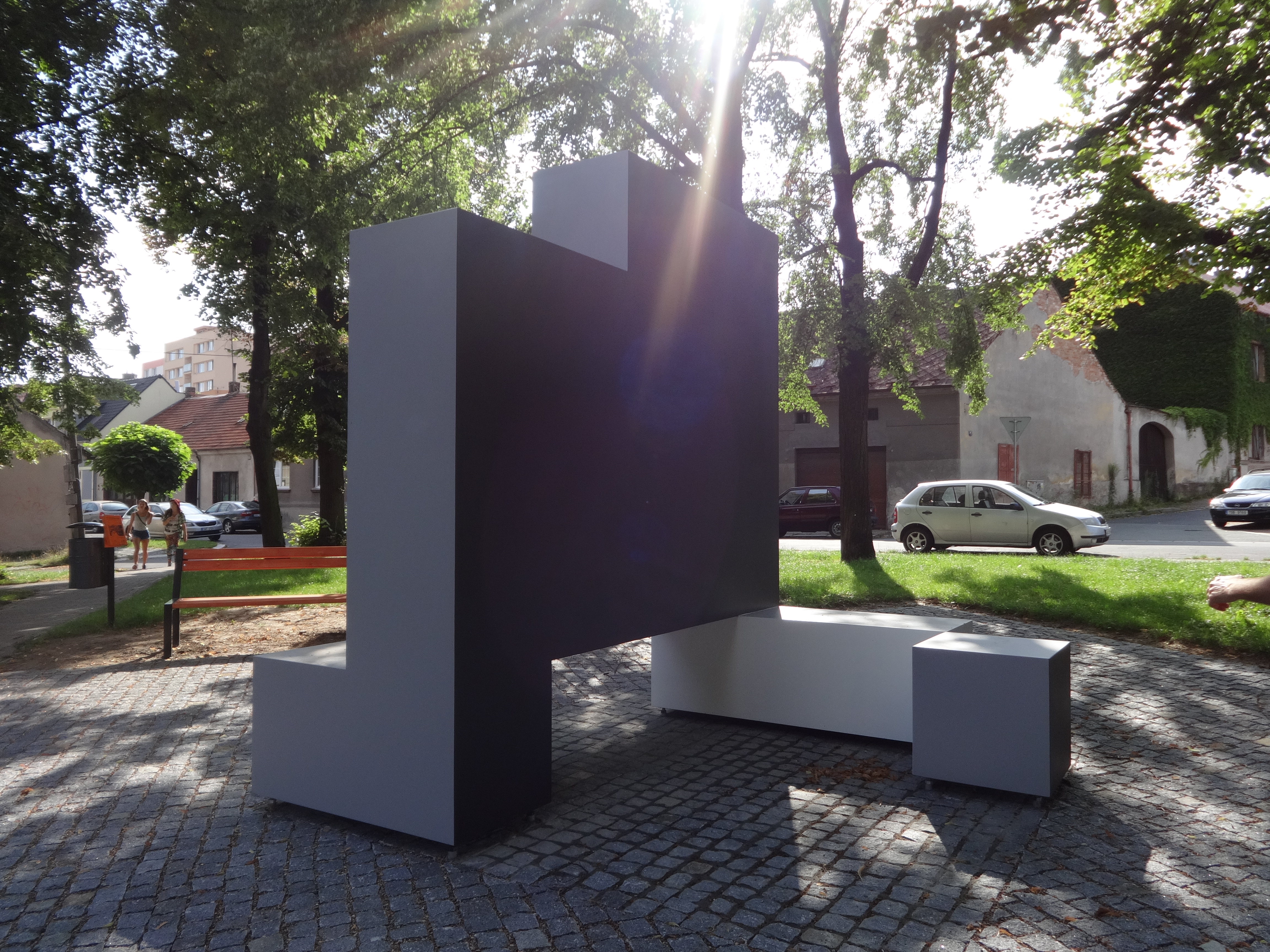
Objects Early in his career Kubíček realised that the third dimension would render his work more complex and complete. Perspex seemed to him the ideal material for this purpose. Moreover, the layering of sheets in space allowed the viewer to see through objects, and multiple layers accentuated colors, proffering tones distinct from those available through the conventional mixing of acrylic paints. "The essence of my geometric work is simplicity and comprehensiveness," said Kubíček. “When I transform my sketches into artefacts made of wood, plastic and other materials, some elements of the construction will always remain hidden from the viewer's eye. Perspex, on the other hand, makes the construction transparent and legible, revealing details otherwise obfuscated by opaque materials." Apart from a bevy of smaller metal artifacts, Kubíček designed a collection of rods and prisms, which were exhibited in the Gallery of Václav Špála in 1969 as a radically minimalist installation. Artistic objects form a unique part of Kubíček’s work—they are limited in number and distinct from his other work. Many objects originate from the mid to late 1960s and have never been exhibited nor publicly examined. Kubíček was aware of the possibilities offered by plastic design. Unfortunately, he was not…
0 comentarii0 vizualizări0 reacții
Jan Kubíčeka lăsat un gând
acum 3 zile
Retrospective
In April 2014, six months after his death, Prague Municipal Gallery held a major retrospective of Kubíček's work, consisting of about 150 pieces from Czech and European collections, curated by Hans-Peter Riese, and signaling a new era for the acknowledgement and appreciation of Kubíček's oeuvre. "Kubíček's work is artistically and spiritually multifaceted, branching off into an incredible variety of directions," wrote Czech art critic Jan Šída.
The following year a consolidated version of Riese's Kubíček retrospective traveled to the Anger Museum in Erfurt, Germany.