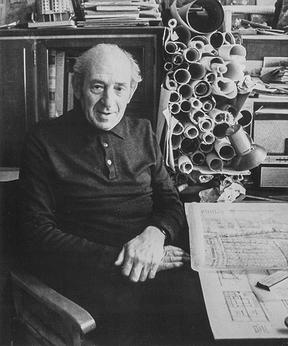
Joseph Yulievich Karakis (or Iosif Karakys; Ukrainian: Йосип Юлійович Каракіс; Russian: Иосиф Юльевич Каракис; 29 May 1902 – 23 February 1988) was a Soviet architect, urban planner, painter, and teacher. He is regarded by some as one of the most prolific architects in Kiev, designing numerous buildings that are now considered architectural landmarks. More than two thousand schools across the Soviet Union were constructed based on Karakis's designs, and in total, more than four thousand buildings were built from his architectural projects.
Joseph Yulievich Karakis (or Iosif Karakys; Ukrainian: Йосип Юлійович Каракіс; Russian: Иосиф Юльевич Каракис; 29 May 1902 – 23 February 1988) was a Soviet architect, urban planner, painter, and teacher. He is regarded by some as one of the most prolific architects in Kiev, designing numerous buildings that are now considered architectural landmarks.
More than two thousand schools across the Soviet Union were constructed based on Karakis's designs, and in total, more than four thousand buildings were built from his architectural projects.
0 comentarii0 vizualizări0 reacții
Joseph Karakisa adăugat o fotografie
acum 3 zile
R.I.P Joseph
Biography Joseph Karakis was born on 29 May 1902 in the town of Balta to Julius Borisovich Karakis (1879–1943), co-owner and worker of a sugar factory in Turbin, and Frida Yakovlevna Karakis (née Geybtman; 1882–1968). He was the eldest child in the family and had a younger brother, David Yulievich Karakis (1904–1970), who became a physician and served as a colonel and chief medical officer during World War II. From 1909 to 1917, Karakis studied at the Realschule in Vinnytsia while attending evening drawing classes taught by Abraham Cherkassky. In 1918, he worked as a painter-decorator at the Vinnytsia Theatre, under Matvii Drak, for the troupe of Hnat Yura, Amvrosy Buchma, and Marian Krushelnytsky. The following year, he joined the Red Army as a volunteer, serving as an artist for the propaganda train. In 1921, he worked as an artist for the Vinnytsia Commission on Monuments and Art of Antiquity, where he contributed to the establishment of the city museum's art gallery and library using the collection from Princess Branitskaya's mansion in Nemyriv. In 1922, Karakis was admitted to the Institute of National Economy at the Faculty of Law. A year later, he entered the Kiev Art Institute, studying in…
0 comentarii0 vizualizări0 reacții
Joseph Karakisa lăsat un gând
acum 3 zile
In Kyiv
Art School (now the National Museum of the History of Ukraine) (1938)
House of Officers – 30/1 Hrushevsky Street (currently houses the Central Museum of the Armed Forces of Ukraine)
Stairs and retaining wall with lanterns at the entrance to the National Museum of the History of Ukraine from Volodymyrska Street
"Model" School No. 29 (co-authored with G. Voloshinov and P. Aleshin; 1929)
Residential building for the Holosiiv Forestry Institute (1931)
House of the Red Army and Navy in Kyiv (1932)
0 comentarii0 vizualizări0 reacții
Joseph Karakisa lăsat un gând
acum 3 zile
Reconstruction of the Aviahorod Club (1933–1934)
Restaurant "Dynamo," near the Dynamo Stadium (1932–1934)
Music School and Concert Hall on Conservatory Alley (1936–1937)
Reconstruction of the Theatre of the Red Army on Meringovska Street (1938)
0 comentarii0 vizualizări0 reacții
Joseph Karakisa lăsat un gând
acum 3 zile
Jewish Theatre, 17 Khreshchatyk Street (1939)
Ten-storey residential building in the constructivist style on Mazeppa (January Uprising) Street (1934–1937)
Residential building, 3 January Uprising Street (1934–1936)
0 comentarii0 vizualizări0 reacții
Joseph Karakisa lăsat un gând
acum 3 zile
Government Quarter (1935–1936)
Residential building, 15–17 Instytutska Street (formerly 25 October Street) (1935–1937)
0 comentarii0 vizualizări0 reacții
Joseph Karakisa lăsat un gând
acum 3 zile
Residential building, St. George Street (1937)
Residential building for senior officers, Zolotovorotska Street (1936)
River Station, co-authored with N. Holostenko (1940)
0 comentarii0 vizualizări0 reacții
Joseph Karakisa lăsat un gând
acum 3 zile
Residential building, 12 Striletska Street (1939–1940)
Residential complex for the State Planning Commission, 25 October Street (1938–1941)
Second stage of the residential block, 5 January Uprising Street (1939–1940)
Housing for the pilot plant, German and Laboratory Streets (1939–1940)
Gallery-type residential building for workers of Kyiv Shoe Factory No. 4 (1940–1941; rebuilt in 1949). The design, typical of southern regions, featured staircases on both sides and open gallery access to apartments, reducing construction costs by 15%.
Gallery-type houses with 50 apartments on Vyshhorod and Nekrasov Streets (1939–1941)
Building at 29 Khreshchatyk Street (destroyed during the explosion on Khreshchatyk, 1941)
Machining shop for the pilot plant (1940)
Experimental School, 12 Boulevard of Peoples' Friendship (1958)
0 comentarii0 vizualizări0 reacții
Joseph Karakisa lăsat un gând
acum 3 zile
Model School (1953–1955)
Experimental School No. 80 (1960; featured a square with a fountain in front)
0 comentarii0 vizualizări0 reacții
Joseph Karakisa lăsat un gând
acum 3 zile
In Begovat (Central Asia)
Farkhad Dam complex: dam, machinery room, diversion canal (2 km long), and aqueduct (1942–1944)
Housing estates "Farhadskaya GES-1000" and "GES-500" (1943–1945)
Detached house for the construction management of the Farkhad Hydroelectric Station (1943)
In Kryvyi Rih, Vinnytsia, and other cities
0 comentarii0 vizualizări0 reacții
Joseph Karakisa lăsat un gând
acum 3 zile
In Kharkiv
House of the Red Army and Navy (1934)
House of Cooperative Societies (co-authored with V. I. Zabolotny and P. Yurchenko; draft, 1940)
School on Louis Pasteur Street (awarded first prize in the contest for best building, 1954)
0 comentarii0 vizualizări0 reacții
Joseph Karakisa lăsat un gând
acum 3 zile
In Kramatorsk
Palace of Culture named after Stalin (co-authored with L. Yurovsky; draft, 1940)
0 comentarii0 vizualizări0 reacții
Joseph Karakisa lăsat un gând
acum 3 zile
In Moscow
Kursk Railway Station (co-authored with L. Yurchenko and S. Tatarenko; draft, 1932)
0 comentarii0 vizualizări0 reacții
Joseph Karakisa lăsat un gând
acum 3 zile
Abrasive Works (1942)
School No. 110 named after Shevchenko for 2,600 students in the Ukrainian district (1969)
0 comentarii0 vizualizări0 reacții
Joseph Karakisa lăsat un gând
acum 3 zile
In Chișinău
Monument to Kotovsky (co-authored with sculptor L. D. Muravina; competition entry, 1947)
0 comentarii0 vizualizări0 reacții
Joseph Karakisa lăsat un gând
acum 3 zile
Other projects
Pilot schools for children recovering from cerebral palsy in Odessa and Berdyansk (1963)
Experimental school for children with intellectual disabilities in Zaporizhzhia (1964)
School with square classrooms in Kramatorsk (1965)
Pavilion-type school building for 2,032 students in Donetsk on the Kalmius River (1965)
Pilot school buildings of large capacity in Makhachkala, Baku, Voroshilovgrad, and Dniprodzerzhynsk (1966–1969)