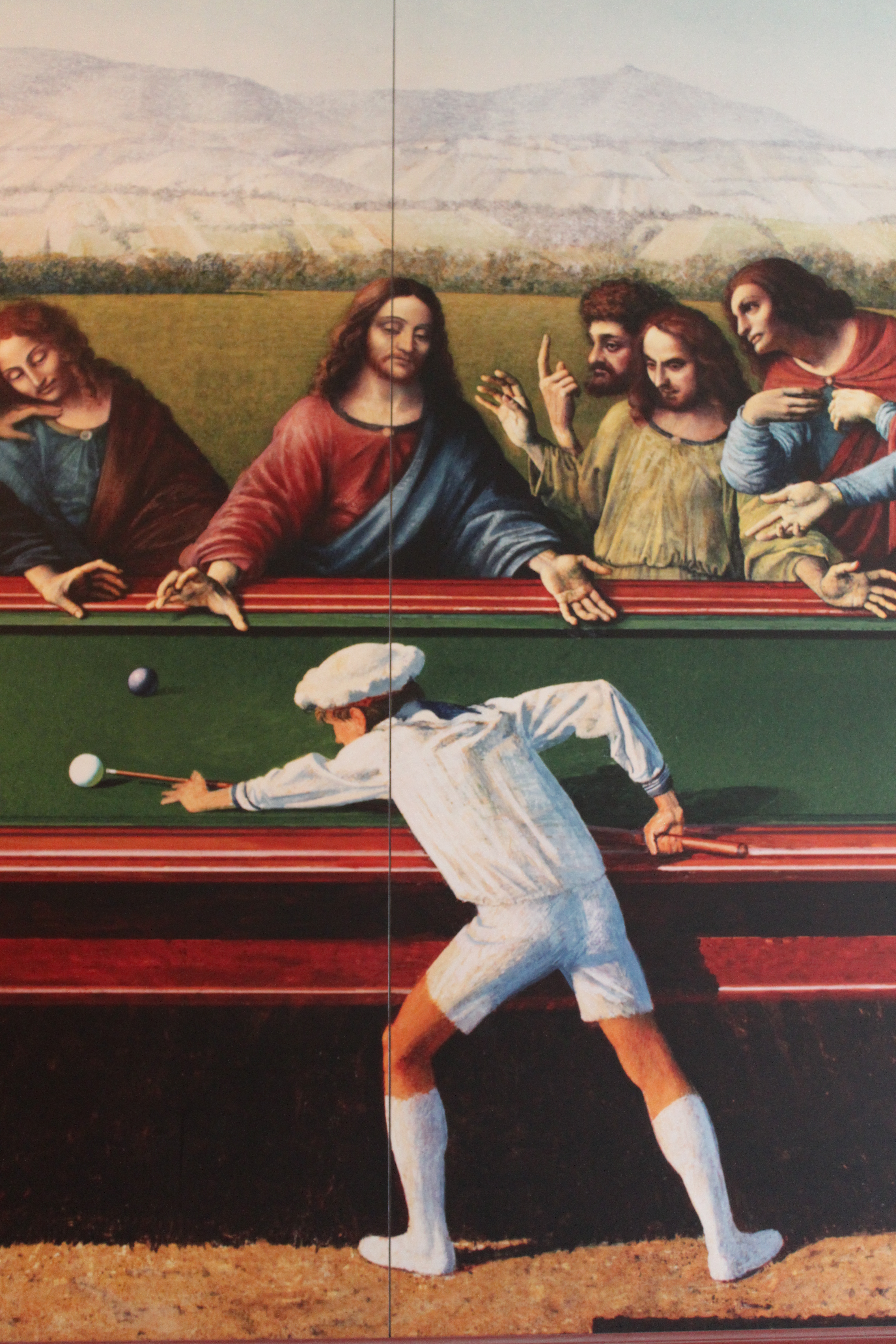
Rudolf Hausner (4 December 1914, Vienna – 25 February 1995, Mödling) was an Austrian painter, draughtsman, printmaker and sculptor. Hausner has been described as a "psychic realist" and "the first psychoanalytical painter" (Gunter Engelhardt).
Rudolf Hausner (4 December 1914, Vienna – 25 February 1995, Mödling) was an Austrian painter, draughtsman, printmaker and sculptor. Hausner has been described as a "psychic realist" and "the first psychoanalytical painter" (Gunter Engelhardt).
0 comentarii5 vizualizări0 reacții
Rudolf Hausnera adăugat o fotografie
acum 8 zile
R.I.P Rudolf
Early life
Of Jewish origins, Hausner's father was a commercial employee, and he worked as a Sunday painter, which made his son enthusiastic about art since early on. From 1923 to 1925 he attended the Schubert Realschule (today Erich Fried Realgymnasium), then the Realgymnasium Schottenbastei in Vienna, until 1931. Hausner studied at the Academy of Fine Arts in Vienna from 1931 until 1936, with Carl Fahringer and Karl Sterrer.
In 1937, Hausner was drafted into the Austrian Armed Forces. In 1938, after the Anschluss, his painting was banned from being exhibited by the Reich Chamber of Culture, considered degenerate art. In 1941 he was drafted into the German Armed Forces. During this time there was his formative traumatic log cabin experience in the Russian Tatra Mountains, which he would reflect in his later works. In 1943, Hausner was dismissed by the Wehrmacht, declared unfit for war, and was employed as a technical draftsman in the armaments industry. In 1944, Hausner married Irene Schmied. During the last days of the World War II he was assigned to an air defense unit.
0 comentarii5 vizualizări0 reacții
Rudolf Hausnera lăsat un gând
acum 8 zile
Following World War II After the war, he returned to his bomb-damaged studio in Vienna and resumed work as an artist. In 1946 he founded a surrealist group together with Edgar Jené, Ernst Fuchs, Maître Leherb (Helmut Leherb), Wolfgang Hutter and Fritz Janschka. They were later joined by Arik Brauer and Anton Lehmden. He joined the Art-Club and had his first one-man exhibition in the Konzerthaus, Vienna. A key work of this period, It's me! (1948; Vienna, Hist. Mus.), shows his awareness of Pittura Metafisica and surrealism in a psychoanalytical painting where the elongated being in the foreground penetrates what was apparently a real landscape, until it tears like a backdrop; another painting, Forum of Inward-turned Optics (1948; Vienna, Hist. Mus.), is evidence of his ability to depict the subject in a realist style while simultaneously overturning the laws of one-point perspective. He married his second wife, Hermine Jedliczka, in 1951; their daughter Xenia Hausner, also an artist, was born the same year. After working on the painting for six years, he completed his masterpiece, The Ark of Odysseus, in 1956. The Ark of Odysseus (1948–51 and 1953-6; Vienna, Hist. Mus.), depicts the hero as a self-portrait and was a…
0 comentarii5 vizualizări0 reacții
Rudolf Hausnera lăsat un gând
acum 8 zile
Bibliography
R. Hausner, Adam und Anima (exh. cat., Bad Frankenhausen, Panorama Mus., 1994)
0 comentarii5 vizualizări0 reacții
Rudolf Hausnera lăsat un gând
acum 8 zile
Sources
Die Wiener Schule des Phantastischen Realismus (exh. cat., Hannover, Kestner-Ges., 1965)
0 comentarii5 vizualizări0 reacții
Rudolf Hausnera lăsat un gând
acum 8 zile
W. Schmied: Rudolf Hausner (Salzburg, 1970)
V. Huber, ed.: Rudolf Hausner: Werkzeichnis der Druckgraphik von 1966 bis 1975 (Offenbach am Main, 1977)
H. Hollander: Rudolf Hausner Werkmonographie (Offenbach am Main, 1985)